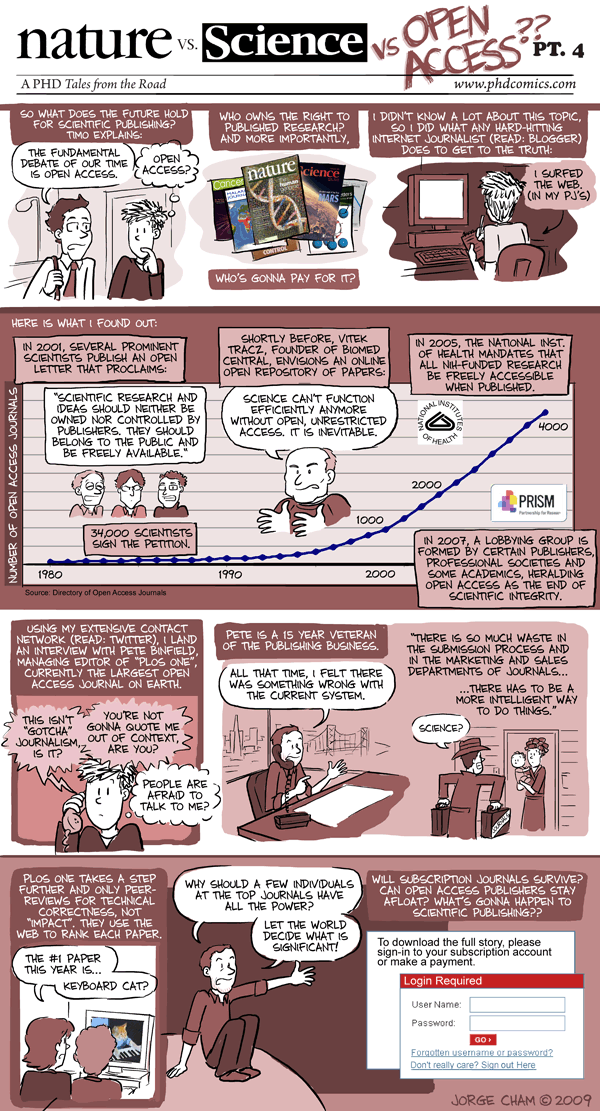
(Oh, and don't miss out on 'Nature vs. Science' Parts One, Two and Three).
On one side are the evolutionary anthropologists. "(They believe) our behaviour is based on things that we did to find mates in our years of evolution," says Alex Bentley, a lecturer in anthropology at Durham University. "Then we have the social anthropologists. Some of them really strongly reject this kind of thinking. They consider it reductionist. They are focused on the specifics of culture."
Put crudely, social anthropologists describe and compare the development of human cultures and societies, while evolutionary anthropologists seek to explain it by reference to our biological evolution. The two sides of the one discipline are struggling to unite.
Do also have a look at the comments, there are some real corkers...
 Science is carrying an interesting editorial this week by Mohamed Hassan, the executive director of the Third World Academy of Science, who argues that, while science has surged in parts of the South, it has stagnated elsewhere. The good news is that developing countries produce 20% of the articles published in international journals. The bad news is that a couple of countries - China, India, Brazil, Turkey, and Mexico - account for over half that proportion. Indeed, according to the figures Hassan quotes, sub-Saharan Africa generates just 1% of international journal articles.
 As I've said before, I strongly support open access. I don't want to sound sanctimonious, but I honestly think the fight for the golden road to open access is one of the most important in academia. So I'm pleased to point out that today, October 14th, is Open Access Day. The day, co-sponsored by PLoS, SPARC, and Students for Free Culture, is meant to "broaden awareness and understanding of Open Access, including recent mandates and emerging policies, within the international higher education community and the general public."
The first of these papers looks particularly interesting and it's related to my research to boot. Expect a review of it soon...
Public Library of Science (PLoS), the poster child of the open-access publishing movement, is following an haute couture model of science publishing — relying on bulk, cheap publishing of lower quality papers to subsidize its handful of high-quality flagship journals.Sigh. I'd respond myself, but I doubt I could be objective. Luckily, Living the Scientific Live has criticized the article at length and Blog Around the Clock has compiled a list of blog reactions.
Open access is good for everyone except those companies with a vested interest in the status quo. We should not let a special interest group stand in the way of a great public good being realized.world-wide electronic distribution of the peer-reviewed journal literature and completely free and unrestricted access to it by all scientists, scholars, teachers, students, and other curious minds. Removing access barriers to this literature will accelerate research, enrich education, share the learning of the rich with the poor and the poor with the rich, make this literature as useful as it can be, and lay the foundation for uniting humanity in a common intellectual conversation and quest for knowledge.

