Showing posts with label Humanities. Show all posts

Thursday, October 16, 2008

Genius and Precocity

Malcolm Gladwell is one of my favorite science journalists and his lengthy New Yorker articles are so excellent (and infrequent) that I invariably link to them. His most recent piece came out a couple of days ago and is entitled "Late Bloomers: Why do we equate genius with precocity?" (See also the audio accompanying the article). Gladwell's conclusion is simple: there is no necessary connection between being a genius and being precocious, that is, some geniuses bloom late. Gladwell relies on the work of the Chicago economist David Galenson, who has produced a series of papers and a book arguing that the distribution of creative genius is bimodal, i.e., that there are two types of geniuses: conceptualists who bloom early and experimentalists who bloom late. As is his style, Gladwell weaves several engaging anecdotes into his overall argument. In this case, he compares the careers of Ben Fountain (who wrote for 19 years without much success and then took the literary world by storm) with Safran Foer (who wrote the best-seller Everything Is Illuminated in 3 months at age 19), and that of Picasso (who burst on the scene at a young age) with Cézanne (who only really became successful in his 50s).

All this is very interesting and if you're at all interested in the topic, I recommend reading the article. But, honestly, I'm not convinced. All of Galenson's data relate only very indirectly to creative genius, that is, he correlates the age of the artist with some proxy for genius, like the auction value of paintings or whether a certain poem has been anthologized often. While I understand why he does this - rigor and the method of economics require hard numbers - I'm not so sure the proffered proxies really track genius. Having to rely on entirely subjective criteria, the art world is notorious for being detached from reality and subject to fads. A great work of art, then, is just what the art world says is a great work of art. So it's possible for an unmade bed to count as "art" and sell for £150,000 (~US$250,000), for an empty room with a light that switches on and off to win a prestigious prize and for an artist's entirely ordinary missing cat posters to be hailed and taken down as souvenirs. Indeed, a particularly apt comparison given the current global situation is the world of finance: how do we know that, say, Cézanne's fame isn't the equivalent of tulip mania that has not burst because there is no underlying reality for it to jut up against? I will no doubt sound like an utter philistine but, frankly, I for one fail to see much merit in Cézanne's work...

Monday, September 29, 2008

Postmodernism vs. Evidence-based medicine

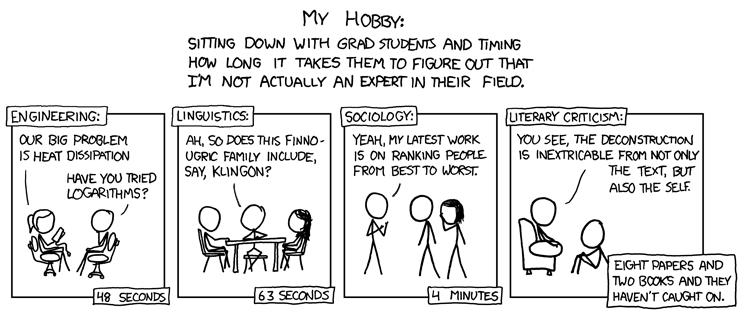
Sigh. The fools who brought us the utterly mind-boggling impenetrable stupidity that is "Deconstructing the evidence-based discourse in health sciences: Truth, power, and fascism" (pdf) are back. Their new piece, "On the constitution and status of ‘evidence' in the health sciences" doesn't quite reach the same level of idiocy as their previous effort, but the stupid still makes my head burn. Luckily, two bloggers far more dedicated and knowledgeable than I have responded robustly. Orac of Respectful Insolence argues persuasively that the new paper is "like a black hole of PoMo stupid". And David Gorski, one of the Science-Based Medicine authors, has a characteristically lengthy piece that demolishes both of the above mentioned articles. I'm honestly grateful to Orac and David - someone has to respond to these wackaloons and I certainly don't have the patience.

(HT for the picture to Bad Astronomy. Somewhat relatedly, I speculated earlier this year about the causes of the uselessness of the humanities here).

Friday, July 18, 2008

Friday fun: Glorious xkcd

So Friday fun has become very sporadic, but today's xkcd is just too good to pass up:

Saturday, July 5, 2008

Evidence matters

Quite possibly the single most dangerous and egregiously misinformed article I have ever laid eyes upon in a peer-reviewed publication is Holmes et. al.'s "Deconstructing the evidence-based discourse in health sciences: truth, power and fascism". I've been meaning to write a blog post about it for ages, but I still haven't been able to finish the paper because reading it makes me want to murder kittens by the dozen... Luckily, Doctor Spurt over at Effortless Incitement has produced a great post on just how deeply idiotic and dangerous the paper really is.

Doctor Spurt even alleges to have read the paper *twice*. Verily, the Doctor has a stronger stomach than I.

Wednesday, March 12, 2008

Jobs for academic types

Benoit Hardy-Vallee, author of the fantastic blog Natural Rationality, has a great little post on what to do with a Ph.D outside academia. He even has a whole section of links to resources for philosophers on finding non-academic jobs! Who would have guessed it? Philosophers in demand!

Monday, March 10, 2008

The New Darwinism in the Humanities

Something a bit more positive about the humanities...

A couple of years ago Harold Fromm, an English studies professor at the University of Arizona, published the best short study of the application of evolutionary psychology to the humanities I have ever come across. The article, published in the Hudson Review, was "The New Darwinism in the Humanities" and came in two parts: "Part I: From Plato to Pinker" (pdf) and "Part II: Back to Nature, Again" (pdf). As I have mentioned before, while I have don't know the literature well enough to sides in internal debates, a scientific approach (with suitable Darwinian infusions) is exactly what I think the humanities needs. A flourishing, successful, scientifically orientated research program may finally loosen the grip of fashionable nonsense such as postmodernism and start bringing the "two cultures" closer together. Done right, such an approach may fetter theorizing in the humanities to the real world, preventing it from drifting randomly.

In any case, Fromm's article is an excellent guide to an emerging field. Give it a try.

Saturday, March 8, 2008

A random, speculative hypothesis regarding the humanities

The requirement of regular accurate feedback for the development of expertize that I mentioned in my previous post made me think (read: speculate wildly)...

Maybe the manifest uselessness of some of those in the humanities can be explained by the fact that they never, or rarely, get suitable feedback. When a surgeon makes a (serious) mistake, a patient dies. When a civil engineer fouls up a calculation, a bridge comes tumbling down. When a vulcanologist prophecies falsely, the volcano shows her up. When a physicist hypothesizes wrongly, the experimental data exposes it. In contrast, an English professor (say), gets no feedback whatsoever from his materials, his subject matter - only from colleagues. And colleagues - unlike erupting volcanoes or a dead patient - can be argued with, dismissed or (seemingly reasonably) rationalized away. As a result, thinking in the humanities can become totally untethered - free to drift capriciously like fads or fashions. The result? Jacques Derrida, Michel Foucault, Luca Luce Irigaray...

Anyway, don't take this too seriously.

Sunday, February 17, 2008

Literary Darwinism: Bridging the Cultures

In his famous 1959 Rede Lecture, "The Two Cultures," C. P. Snow argued that there existed a worrying divergence and growing incompatibility between two sorts of intellectual: scientists and literary intellectuals. Alas, almost 50 years later, many of the problems Snow identified remain and have probably even grown: witness the dominance of post-modernism, post-structuralism and other woo in the humanities. (This despite pointed and seemingly decisive criticisms).

So it's certainly a good thing that there is a group of researchers, Literary Darwinists, who are helping, in a modest way, to bridge the chasm from both ends. Jennifer Schuessler, writing on the NYT blog Paper Cuts, reviews a recent addition to this literature: Comeuppance: Costly Signaling, Altrusitic Punishment, and other Biological Components of Fiction by William Flesch. (Full disclosure: I haven't actually read the book, only about it). Flesch, professor of English Literature at Brandeis, seems to have solid humanities credentials, which means it's harder to portray Literary Darwinists as consisting solely of cold-hearted and naive scientists trying to colonize the humanities. Imagine that, scientists and English professors working on a single research program...

While I haven't read Flesch's book, I have ventured into other parts of the Literary Darwinist literature, mainly Joseph Carroll's work, and, speaking generally, I think it's exactly the sort of thing that should be happening. I don't know the field nearly well enough to have strong opinions, or to take sides in particular debates, but it's clear evolutionary psychology needs some account of literature and art generally. If we are aiming to provide a naturalistic (and pomo/nonsense-free) understanding of human behavior, it's clear we can't shy away from tackling distinctively human activities such as the creation and enjoyment of literature. Moreover, I would be extremely surprised if knowledge of our evolved mental architecture did not contribute to literary studies - so it's hardly only a matter of literature constituting a 'problem' for scientists to solve, a Darwinian perspective on literature might end up enriching the humanities.

(See also: D. T. Max's "The Literary Darwinists" in the NYT Magazine and Harold Fromm's fantastic "The New Darwinism in the Humanities": Part 1 [pdf] and Part 2 [pdf]).