Showing posts with label Journalism. Show all posts

Sunday, January 2, 2011

A Modest Proposal: Take "News" out of "Science News"

While there are fantastic science journalists out there, unfortunately, science journalism as a whole is in a rather shocking state. Why this is so is endlessly debated, but my Modest Proposal is that there is far too much "news" in "science news".

Before we continue, I should say that I take it 'our' goal is to educate the public about both the findings and the methods of science. Of course, the mainstream media (MSM) is in the profit-making business, not in the education business. The science boosters among us (yours truly included), however, would like to square the MSM's profit motive with our educational goals, hence this post and many others like it.

In any case, here is the crux of my view that there is too much news in science news, expressed neatly as a slogan: Context Is King. It is an unfortunate fact, but the public is abysmally ignorant of science. (The data are best for the US, but there is no reason to think it's dramatically better elsewhere). Moreover, science is hard and often counterintuitive. So, to make any real sense of what's new - i.e. what's news - one needs to have at least some grip on what's already known, one needs background. If I don't know the first thing about human evolution, for example, it's going to do me no good to hear about the discovery of the Denisovans. If I don't know anything about the methods of science, a scientific controversy - the recent arsenic bacteria thing, for example - is going to baffle me. (Or I'm going to walk away with serious misconceptions at the very least). None of this should be particularly surprising, of course, nor is it unique to science. If I don't know the rules of American football (and I don't really), NFL news is going to make little sense to me.

The problem, though, is that often the MSM in effect assumes the public already has the necessary background knowledge to make sense of science news because their articles contain little or no context. The result is not merely a public that fails to learn about and appreciate new discoveries, it's a public that's positively misled about the findings and methods of science. My remedy is that science journalists change their focus: their aim shouldn't be to convey the newsy bit of science news, it's to convey the sciency bit of science news. And that means recognizing Context Is King: explain what we already know in the necessary detail in order to convey what we might just have found out. Obviously, this is hard. It takes work. And, whaddaya know?, it requires actually knowing something about science. (I'm looking at you, Richard Alleyne).

I should hasten to add, by the way, that there are already a bunch of science journalists who do exactly what I suggest. Ed Yong, Carl Zimmer, Malcolm Gladwell et. al. do not need advice from me about the importance of context. Indeed, any MSM journalist who would like to learn to do science journalism right can't do much better than reading the Yongs and Zimmers.

Wednesday, September 8, 2010

Climate denialists believe the darnedest things

You may recall that back in February I took on Daily Maverick columnist and climate denialist Ivo Vegter. Following on from my then just-published piece on deference, I argued Vegter was incredibly arrogant to take a stance contrary to the scientific consensus on climate change when he's a journalist - not a climatologist or even a meteorologist. Vegter entertainingly replied. While I replied in turn in the comments of his blog (I liked this one) and occasionally engaged in Vegter-baiting on Twitter, I always meant to reply properly via my blog. But then I got married, ran a bunch of psychology experiments, moved cities, etc. and I never got round to it. Anyway, a recent exchange gave me some impetus. I asked Vegter, putting aside causes, whether he accepts the simple fact that the average global temperature has been increasing. Since it would be enormously idiotic to deny it has - you'd have to believe in a nearly-impossible grand conspiracy - Vegter replied: "I'm on record agreeing to warming until 1940, cooling '40-'70, warming '70-2000." But... believing warming has occurred but then denying it's anthropogenic, I submit, requires you to believe the darnedest things.

First of all, let's review what the instrumental temperature record looks like:

Source
The black line is the annual air temperature mean, the red line is a five-year running average and the green bars are confidence intervals. It's clear from the graph that Vegter is more-or-less correct about the temperature record: we observe warming until about 1940, cooling or more likely a plateau from 1940 to around 1975, and warming since. (Vegter is dead wrong to think warming stopped in 2000: 2009 is the second warmest year on record - after 2005. The 2000s is the warmest decade on record. June 2009 to May 2010 is the warmest 12-month period on record. And 2010 is shaping up to be the warmest year on record).

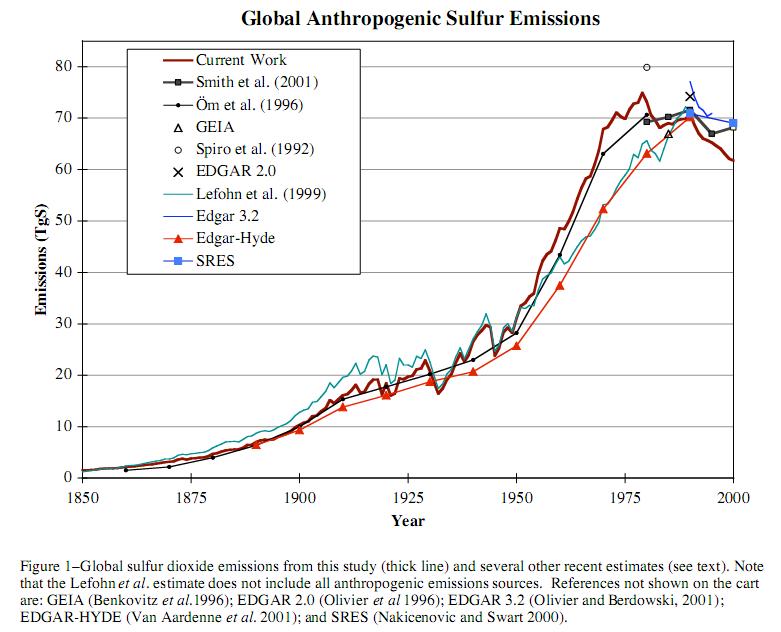
How does the mainstream scientific community explain this pattern? Why was warming interrupted from 1940-1975? Here is a very simplified explanation: the early (~1915-1940) warming trend has a different explanation to the ~1975-2010 warming trend, and the cooling in between has yet a third explanation. The earlier warming was due to "a combination of factors, including a lull in volcanic activity (therefore the absence of its cooling influence), a slight increase in solar output, and yes, an increase in greenhouse gases too (although not nearly so much as during more recent times)". The second warming period was caused largely by our industrial emissions: mostly CO2, but other greenhouse gases played a role. The lull in warming from 1940-1975, in turn, was due to anthropogenic cooling due to global dimming. The quick version is that aerosols such as sulfates increased very rapidly from about 1940 to about 1975 (spot the relationship?) and then declined again rapidly. In other words, the warming forcing of the greenhouse gases was masked by the cooling forcing of various aerosols, and the rapid decline of the latter after 1975 meant net radiative forcing suddenly turned positive - resulting in warming. While this is undoubtedly complicated (though, what would you expect?) and may even seem contrived, it is important to note that this version of events is consistent with the available data and no other scenario is consistent with the available data.

But how does someone who agrees that global warming has occurred but denies anthropogenic forcing is responsible, explain the observed temperature record? (And, importantly, the pattern of warming). To think both the above propositions true, you have to believe the darnedest things: (1) that some mechanism entirely unknown to science inhibits or obviates the warming effects of our greenhouse gas emissions and (2) that some other mechanism entirely unknown to science caused the warming that has been observed. We know beyond all reasonable doubt that carbon dioxide is a greenhouse gas - it's a basic finding of physics, established under the most rigorous laboratory conditions. We also know, beyond all reasonable doubt, that the atmospheric concentration of greenhouse gases has increased dramatically because of our industrial emissions since the Industrial Revolution. To think these two facts don't combine to produce warming is to think that there is something (no one knows what) that somehow (no one knows how) inhibits the warming that would normally occur. But worse, there is yet something else (no one knows what) that actually caused to warming we see. (Something must cause it! And it's not the sun, in case you were wondering).

To be a climate denialist, then, you need to believe at least one of the following: that there is a grand conspiracy among scientists to withhold the truth about the climate record or that, extraordinarily improbably, (1) and (2) are true. On the first, note that there is no precedent in all of history for the existence of a conspiracy on the scale climate scientists have been accused of. ("Climategate" was a non-event. No fewer than three independent inquiries concluded there was no serious misconduct). On the second, extraordinary claims require extraordinary evidence and, as far as I know at least, no one has yet provided convincing, let alone extraordinary, evidence for either (1) or (2).

My Zimbabwean two cents worth: Vegter is no idiot (I actually quite like him) and, unlike several other climate denialists, I think it highly unlikely he's in the pocket of Big Pollution. My view is that he suffers from immense confirmation bias given that, as a libertarian, he doesn't want global warming to be true. One thing is clear, though, and this should give Vegter some comfort: the truth of climate change is logically independent of what our political response to it should be. It is possible to think - as Bjorn Lomborg's new book demonstrates - that climate change is real and a serious problem, without thinking policies libertarians despise are the remedy. A final note: as George Monboit nicely illustrated recently, there is honor is saying "I was wrong". Ivo, it's time to change your mind.

Friday, August 27, 2010

How bad is mainstream science reporting?

Zoƫ Corbyn has a good feature in the Times Higher Education Supplement on the state of science journalism. It's a very interesting read, and does a good job of surveying the various positions people take on the quality of science journalism. I'm neither going to summarize Corbyn's article nor comment on all of it, but I do want to make a point about the clash of values between journalists and scientists. It will help if you've read the article before continuing reading here...

Ok, welcome back. Here is the bit that I want to comment on:
[Andy] Williams attributes much of the bad feeling that exists to a "disparity of interests". The "news values" that drive journalists - such as the need for conflict and newness - are very different from the values and motivations of scientists.
"Scientists don't understand that it is not the job of journalism to be a science communicator. It is the job of journalism to tell a story to sell a paper or gain a bigger audience: that is a basic fact of life, but it's also the root of a lot of bad feeling.
"So many of the things that scientists complain about in the reporting of science stem from the fact that information in the news media is not primarily for the public good. It is about turning information into a commodity to be sold in the market. That is the cause of most of the problems in one way or another ... I don't think scientists will ever like what the media do: they have a different set of motivations."
This strikes me as exactly right. But here is my question: how do scientists and those who care about science communication influence the media's values? Assuming we science-boosters care about truth and accuracy above all else, and the media cares about commercial interests first and then only about accuracy, how can we nudge mainstream journalists in our desired direction? Why, by making it in their commercial interest to be accurate! And, it seems to me, people like Ben Goldacre are doing an excellent job of doing exactly that. Naming and shaming bad science journalism affects the reputation, and thus market position, of the newspapers thus named and shamed (and possibly even the employability of the journalists). Were it to be generally realized, for example, that one should never ever trust the Telegraph's science reporting (especially not Richard Alleyne's), its reputation would take (something of) a hit, and will thus affect its commercial interests. It may even make editors think twice about giving sports journalists a science gig.

What I'm saying, in other words, is that an occasional pistol-whipping (what Jeremy Laurance accused Goldacre of) is one way for those of us who care about truth and accuracy to make the mainstream media care more about truth and accuracy. (By the way, see Goldacre's response to Laurance). There are, of course, other ways of improving the media's accuracy, but naming and shaming (along with more constructive criticism, of course) is one excellent way.

Friday, July 30, 2010

Solid Rock: Preying on the desperate, ignorant and gullible

Here is some good news: South Africa's Advertising Standards Authority (ASA) is doing its job. A church called "Solid Rock Church of Miracles" (warning: horrid late-90s web design...) ran an ad with an accompanying photograph as 'evidence': "Bring the blind, the lame, Aids and cancer victims. 43 Crutches! 25 Walking sticks! 2 White canes from blind people! Already left behind!". In other words... WE DO MIRACLES! Never mind those doctors! Jebus will take care of you! And if you bring along some cash to stuff into our collection boxes, that would be great... Given that praying really, really hard to an invisible sky wizard cannot, in fact, cure AIDS, cancer, blindness or lameness, taking out such an ad preys on the desperate, ignorant and gullible.

Thus, thankfully, ruled the ASA. The reaction of Solid Rock's pastor - former bike gang-member Johan van Wyk - has been rather amusing and more that a little risible. Despite the fact that the miracles bit is in their name and in their mission statement van Wyk told the ASA he's not "claiming anything in these advertisements. It just encourages people to bring everybody. The crutches etc. are hanging in its church so there is no false claim". Right... there are crutches hanging in my church, nobody ever reads between the lines in advertisements, therefore I am not a lying bastard... But why is van Wyk being so coy? Well, maybe it's the five previous rulings against his church. The ad in question, notes the ASA, bears a "striking resemblance" to other ads for which it has already been sanctioned.  "As with all previous rulings," concluded the ASA, "the current advertisement promotes the church, under the auspices that it can cure various diseases or offer treatment for them. The respondent is clearly continuing to make unsubstantiated healing claims despite an instruction not to do so."

And van Wyk's reaction to the ruling? From the Sunday Independent: 
"Look, for our members and for ourselves, miracles are very real," Van Wyk told the Saturday Star of the divine healing he claims happens at the Northcliff, Joburg, church come weekends. "Every weekend we experience miracles and hear testimonies. For us they're very real ...The person most blind is the one who doesn't want to see. Our business is not about proving miracles; it's to help people."
Aside from the surprisingly post-modernist "for us", this is a fascinating insight into the religious mind. There is no room for careful consideration, for even a modicum of doubt, or even for expertise. ('A doctor attended services?' GREAT!). All we have is assertion, emotion, and a petulant demand to be believed. Think about it. If this guy really can cure AIDS, he has a moral duty to present the kind of evidence that would convince a skeptic. But all we're given is unsubstantiated anecdotes - testimony from the emotional and medically untrained, given to the emotional and medically untrained.

Most frustratingly, the bad publicity has likely done the church good:
The church, it seems, has reaped the benefits. "The lady (Phillips [who laid the complain with the ASA]), instead of stopping us, we've had so much publicity. If people will come because of that, we'll have to see.
"We don't advocate everybody will be healed here. But through all these years, only one person has ever complained. She (Phillips) is harming the sick people, not us."
It's time for the ASA to put some bite in its rulings. Any organization that consistently flouts the ASA's judgments deserves to be punished - as severely as the law allows.

Tuesday, June 8, 2010

Picture: Zapiro's follow-up

In all the hullabaloo over Draw Mohammad Day, I forgot to point to cartoonist Jonathan "Zapiro" Shapiro's follow-up cartoon. You'll recall that this cartoon of Zapiro's - in my view one of the best drawn for Draw Mo Day - caused quite a stir, and Shapiro even received death threats. Anyway, Zapiro followed-up with the following (click for a bigger version):

Tuesday, February 2, 2010

Telegraph Science Journalism Fail: Or, ARRRRGHHHH!!!111!

I was alerted to an absolutely daft article in the Telegraph via Derren Brown's Blog (who, disappointingly, didn't seem to notice it's daft). Basically, the article completely misrepresents a paper, "Bonobos Exhibit Delayed Development of Social Behavior and Cognition Relative to Chimpanzees", in press at Current Biology. The paper showed, roughly and among other things, that both bonobos and chimps are cooperative when they’re young, but then chimps become progressively less cooperative and more competitive with age, whereas bonobos don’t. The authors hypothesize that this may be due to pedomorphosis, that is, evolutionary changes to the developmental pattern such that juvenile characteristics persist into adulthood.

The 'science correspondent' at the Telegraph, one Richard Alleyne, however, would have you believe the researchers involved "now believe that being aggressive, intolerant and short-tempered could be a sign of a more advanced nature." How the hell Alleyne got from the paper to THAT conclusion is utterly beyond me, the researchers never even hinted that there is connection between 'civilization' and their findings. Alleyne goes on to commit a bunch of science howlers: among other things, saying chimps are "more evolved" and that chimps and bonobos are monkeys (ARGH). Anyway, I was going to blog about this in more detail, but luckily Alison Campbell at BioBlog has a most excellent take-down of the article, so go there for more (and more competent) analysis.

By the way, this is not the first time Alleyne has gotten it spectacularly wrong. Ben Goldacre has exposed his breathtaking misinterpretation of climate science (which he refused to correct) and his shameful distortion of a graduate student's MSc thesis which he claimed concluded women who get raped, essentially, were asking for it (at least this was half-heartedly and partially corrected). 

In conclusion: 

Thursday, January 28, 2010

Rational thoughts about homeopathy

I never cross-posted this from (the defunct group-blog) The Intrepid Aardvark, so here it is now (slightly edited).

The most excellent Leonie Joubert (a journalist and acclaimed author) had a great Mail & Guardian column about homeopathy a while back. Writes Joubert:
I've taken my share of homeopathic remedies over the years and have given the same assertion that most users do: "I tried it when I had x-y-z and I got better." Well, maybe the placebo effect was strong, or I was going to get better anyway (after all, illnesses either run their course or kill you). Personal anecdote isn't evidence of efficacy.

What's the harm in a bit of placebo effect, dressed up as a legitimate remedy? Britain's Royal Pharmaceutical Society agrees there's place for "harmless faith-based ­remedies". But when a cancer patient abandons chemo or a kid's eardrum ruptures because the infection didn't get treated with more than sugar pills, that's another matter. And my medical aid payments are subsidising another's sham treatment. That irks.
Also check out Leonie's blog. Oh, and I reviewed Leonie's book, Scorched, some time ago.

Friday, July 24, 2009

Fun with the Economist

The Economist has a bunch of cool recent articles, so I thought I'd link to some of them.

Richard Dawkins is not popular in some circles, indeed, he's attracted a whole host of critics or, as he puts it, "fleas". The latest is "The Selfish Genius: How Richard Dawkins Rewrote Darwin’s Legacy" by Fern Elsdon-Baker, a philosopher at Leeds University. The Economist has a good review of the book, which concludes Elsdon-Baker misses her mark. I especially liked the final paragraph:
What is left, once these attacks are dismissed, is a critique of Mr Dawkins’s proselytising atheism. It is true this wins him few converts, when a collaboration with religious moderates against the creationists might bear weightier fruit. But if his intellectual rigour forbids him making common cause with people he thinks are wrong, that perhaps only shows he is indeed the rottweiler of legend.
The Lexington column had a interesting piece about Camp Inquiry, an American summer camp for atheist / freethinking children. (If you listen to Point of Inquiry, you've no doubt heard about it before). I was somewhat surprised (though, I shouldn't have been) that the camp has been strongly condemned by fundamentalists like the nuts over at AiG. I'm always amazed how controversial teaching critical and independent thinking is.

The Economist is renowned for its dry, pithy, final sentences. Indeed, it's joked that the ability to pen such lines is more important for being hired as an Economist journalist than anything else. Anyway, I thought the closing sentence of this article on searching for Dark Matter was wonderfully crafted and apposite.

Oh. And I just can't resist linking to this review of a book on World War II. The sub-heading: "A British historian argues that Hitler lost the war for the same reason that he unleashed it—because he was a Nazi." Glorious.

Wednesday, July 22, 2009

Gladwell's latest

Malcolm Gladwell has a new piece out in the New Yorker about overconfidence. He argues, in brief (and among other things), that when we become overconfident we blur the line between things we can control and things we cannot. A particularly interesting bit:
The psychologist Ellen Langer once had subjects engage in a betting game against either a self-assured, well-dressed opponent or a shy and badly dressed opponent (in Langer’s delightful phrasing, the “dapper” or the “schnook” condition), and she found that her subjects bet far more aggressively when they played against the schnook. They looked at their awkward opponent and thought, I’m better than he is. Yet the game was pure chance: all the players did was draw cards at random from a deck, and see who had the high hand. This is called the “illusion of control”: confidence spills over from areas where it may be warranted (“I’m savvier than that schnook”) to areas where it isn’t warranted at all (“and that means I’m going to draw higher cards”).
While this article certainly isn't among Gladwell's best work, it's still worth the read.

Related: Dan Ariely on how we are influenced more by confidence than by expertise. Disturbing thought, especially for scientists who are trained to be careful about their claims.

Saturday, March 21, 2009

Clay Shirky on newspapers and the web

Ok, so this is seriously off topic, but Clay Shirky's post about the impact of the web on newspapers, and the revolution in how we manage information more generally, is an absolute must read. Shirky argues, in brief, that there is nothing natural or inevitable about how journalism is current conducted -- it's simply a product of the economics of the printing press. And, rather disconcertingly, we simply don't know -- can't know -- what system will replace the current one. A snippet:
Round and round this goes, with the people committed to saving newspapers demanding to know “If the old model is broken, what will work in its place?” To which the answer is: Nothing. Nothing will work. There is no general model for newspapers to replace the one the internet just broke.
With the old economics destroyed, organizational forms perfected for industrial production have to be replaced with structures optimized for digital data. It makes increasingly less sense even to talk about a publishing industry, because the core problem publishing solves — the incredible difficulty, complexity, and expense of making something available to the public — has stopped being a problem.

Wednesday, January 28, 2009

Financial feng shui bollocks

The world faces its greatest financial and economic crisis since the Great Depression. If there was ever a time to make prudent, rational, decisions based on a clear-sighted analysis of the facts, now is it. And yet Reuters decided to publish this piece of utter nonsense about what feng shui “masters” predict for the rest of the financial year. (I first saw it syndicated in the business section of South Africa’s Sunday Independent). Apparently, 2009 is the “Year of the Ox” and also a “yin earth” year, which means it “will be the most peaceful year globally since 2000” and the markets will thus be “calmer, if subdued”. Vincent Koh, a Singaporean feng shui “master”, advises that you avoid “high-risk assets” and remain patient. He also thinks banks will “continue to be reluctant to lend”, diseases will spread and natural disasters (landslides, floods and earthquakes) will strike the northern hemisphere (but not exclusively).

Sigh. I probably don’t need to say this, but there is just no reason at all to think that feng shui is anything other than silly superstition invented when humanity didn’t know any better. (Yes, it’s ancient. But that doesn’t mean anything). Feng shui may be interesting, or stimulating, or valuable in some vague sense, but it’s very likely false and it’s almost certainly worthless as a tool for predicting the future or ‘attracting wealth’. Look at those predictions again: they’re almost all either uselessly vague or high-probability hits. You don’t need a magical ability to detect 'metaphysical energies' to tell you 2009 will likely be calmer than 2008 – last year was so tumultuous that regression to the mean alone predicts that. And of course diseases will spread, landslides will occur, floods will sweep in and earthquakes will strike. That happens every year. And of course most of these will occur in the northern hemisphere: there are more people there (so we’re more likely to hear about it) and there is more land there (so they’re more likely to occur in the first place). And, of course avoiding “high-risk assets” is a good idea. But my gran could have told you that. And of course banks will still be reluctant to lend, it’s still not clear how much certain toxic assets are worth (if anything at all), so banks continue to be risk averse.

Despite some token skepticism in the article about how financial feng shui doesn't have a great track record, overall, the article is credulous crud. The Reuters editors ought to be ashamed of themselves for publishing such irresponsible and irrational bollocks.

Monday, December 8, 2008

Gladwell's latest

Malcolm Gladwell, the master scientific raconteur, is at it again with a New Yorker article (indirectly) about the Peter Principle. The principle, as many of you will know, states that "In a Hierarchy Every Employee Tends to Rise to His Level of Incompetence"; which then raises the question of how to decide whether to give people a raise, or hire a person into a position a step up in the hierarchy. It's this latter question Gladwell address, arguing that there are several fields - NFL quarterbacks, teachers and financial advisers - where it is impossible to know whether a candidate will succeed or fail. An excerpt:
There are certain jobs where almost nothing you can learn about candidates before they start predicts how they’ll do once they’re hired. So how do we know whom to choose in cases like that? In recent years, a number of fields have begun to wrestle with this problem, but none with such profound social consequences as the profession of teaching.

...

In teaching, the implications are even more profound. They suggest that we shouldn’t be raising standards [for hiring teachers]. We should be lowering them, because there is no point in raising standards if standards don’t track with what we care about. Teaching should be open to anyone with a pulse and a college degree—and teachers should be judged after they have started their jobs, not before... [The teaching profession] needs an apprenticeship system that allows candidates to be rigorously evaluated.