Showing posts with label Skepticism. Show all posts

Thursday, February 24, 2011

Dr. Uba... FAKE

The South African interwebs is up in arms about one  Dr. Uba, who apparently offers cash for body parts. In flyers distributed in Johannesburg and a website, Dr. Uba offers "keen cash" for eyes, penises and kidneys and more.

This, understandably, quickly drew a lot of attention. Twitter exploded with outrage, Reddit got in on the act, the police was apparently sniffing around, and I was notified about the site via email and Facebook by several independent sources. Since human body parts are sometimes used for "muti" (traditional African medicine) and since this kind of quackery flourishes in South Africa, alas, Dr. Uba existing didn't strike me as impossible. But, as I've pointed out before, doubt will set you free. With some ninja internet skills and the help of several friends, I manage to uncover that Dr. Uba is nothing more than a guerrilla marketing campaign for the upcoming South African horror-film "Night Drive" (a trailer is here).

To make a long, convoluted story very short... The first indication that Dr. Uba wasn't real was that the Whois for the site revealed it was registered to one Jonathan Merry (this is he, I think) who works for a design / marketing company. Additionally, if you phoned Dr. Uba's clinic, all you got was voicemail. Much more significantly, the Whois description of the site is "spoof site of fake doctor". That confirmed the site is a fake, but not why it was being faked. Contacting Mr. Merry revealed few additional details (he was constrained by his client, apparently), so the motives for site remained hidden. Then, rather anticlimactically, the site was edited so that clicking on any of the links showed:

Wednesday, November 24, 2010

Lazy Linking

"Psychopathy seems to be caused by specific mental deficiencies"
  • The Economist reviews research that used the venerable Wason selection task to reveal psychopaths seem unable to understand social contracts. This suggests (albeit weakly) that psychopathy is a frequency-dependent adaptation. 
  • Time magazine profile of the courageous James Onen, head of Freethought Kampalaan organization dedicated to science and reason in a highly superstitious country.
    "The Shadow Scholar"
    • Disturbing Chronicle of Higher Education profile of an 'academic mercenary' paid to write essays and other academic work for students. Scary stuff.
    • It seems to me that there is little academics themselves can do about this problem. If I suspect a student has paid someone to do her work for her, then what? I... hack her email account? The only long-term solution, it seems to me, is to criminalize the companies that provide these services - after all, they're arguably committing (or at least abetting) fraud. When the companies' records are seized, guilty students should be tracked down and punished. Degrees should be withdrawn, etc. I'm not saying this will solve the problem completely, but it'll at least lessen it, and provide some deterrent. 
    "Freaks, Geeks, and Economists"
    • The subtitle says it all: "a study confirms every suspicion you ever had about high-school dating".
    • Fallacies categorized and their family relationships mapped. Good stuff. 
    "This Is Your Brain on Metaphors"
    • Robert Sapolsky does great work, and this piece is as good evidence of that as any. He reviews a bunch of research which demonstrates that the brain conflates the literal and metaphorical. That is, certain 'higher' mental functions (like morality) is simply bolted onto 'lower' mental functions (like disgust). 
    • "Nelson Mandela was wrong when he advised, “Don’t talk to their minds; talk to their hearts.” He meant talk to their insulas and cingulate cortices and all those other confused brain regions, because that confusion could help make for a better world."
    "Tanzania's first elected albino MP fears for life"
    • What's the harm? This. This is the harm. 
    • Quacks + poachers = rhinos in trouble.
    "Not so fast... What's so premature about premature ejaculation?"
    • Jesse Bering strikes again. Premature ejaculation from an evolutionary perspective... Be sure to read the incisive comments.
    • Profile of Arthur Goldstuck, premiere cataloger of South Africa's urban legends. I attended the book launch, and I've read his latest book (The Burglar in the Bin Bag). Very good stuff. 
    • Arthur is on Twitter as @art2gee and blogs at Urban Legends.
    "What’s In Placebos?"
    • Apparently placebos are not all alike. Steven Novella covers the fascinating details and discusses the consequences. 
    "Palestinian Blogger Angers West Bank Muslims"
    • It's not exactly surprising that an atheist is unwelcome in the West Bank, but (1) it's still lametable that he isn't but (2) heartening that he exists at all. 
    "10 Bizarre Medical Discoveries"
    • Sample: symptoms of asthma can be treated with a roller coaster ride... 
    "Kasparov versus the World"
    • The fascinating story of Gary Kasparov's epic game against the rest of the world (well, a huge number of chess players who collaborated online). Kasparov called it "the greatest game in the history of chess".
    "The glorious mess of real scientific results"
    • This is written by Ben Goldacre. Go, read.
    "Calculate the Effect of an Asteroid Impact on Earth"
    • Go on, what are you waiting for? You know you want to...
    "Putting a Hex on Hitler, 1941"
    • Life covers a batty attempt to defeat Hitler... with witchcraft. 
    "There Are 5,000 Janitors in the U.S. with PhDs"
    • :-(
    • Another Economist piece, this time a review of the book A Wicked Company: The Forgotten Radicalism of the European Enlightenment. According to the review, the book is the story of the salon presided over by the (unjustly forgotten - but not by me) Baron d'Holbach
    "The Fascinating Story of the Twins Who Share Brains, Thoughts, and Senses"
    Pretty / WOW / heh

    "'Dance Your Ph.D. 2010' Winner Announced"
    • This is just wonderful. Watch the video, srsly.
    "National Geographic's Photography Contest 2010"
    • Must see gorgeousness from Big Picture.
    "Wildlife through the lens"
    • Beautiful wildlife photography.
    "The Difference Between Jesus and Zombies"
    • heh
    "What I Think About Atlas Shrugged"
    • Sci-fi author John Scalzi rips into Ayn Rand. Hilarity results. 

    Wednesday, September 8, 2010

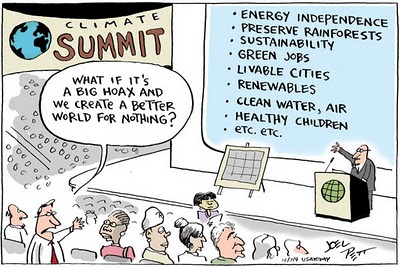
    Picture: Climate solutions comic...

    Most excellent...

    Climate denialists believe the darnedest things

    You may recall that back in February I took on Daily Maverick columnist and climate denialist Ivo Vegter. Following on from my then just-published piece on deference, I argued Vegter was incredibly arrogant to take a stance contrary to the scientific consensus on climate change when he's a journalist - not a climatologist or even a meteorologist. Vegter entertainingly replied. While I replied in turn in the comments of his blog (I liked this one) and occasionally engaged in Vegter-baiting on Twitter, I always meant to reply properly via my blog. But then I got married, ran a bunch of psychology experiments, moved cities, etc. and I never got round to it. Anyway, a recent exchange gave me some impetus. I asked Vegter, putting aside causes, whether he accepts the simple fact that the average global temperature has been increasing. Since it would be enormously idiotic to deny it has - you'd have to believe in a nearly-impossible grand conspiracy - Vegter replied: "I'm on record agreeing to warming until 1940, cooling '40-'70, warming '70-2000." But... believing warming has occurred but then denying it's anthropogenic, I submit, requires you to believe the darnedest things.

    First of all, let's review what the instrumental temperature record looks like:

    Source
    The black line is the annual air temperature mean, the red line is a five-year running average and the green bars are confidence intervals. It's clear from the graph that Vegter is more-or-less correct about the temperature record: we observe warming until about 1940, cooling or more likely a plateau from 1940 to around 1975, and warming since. (Vegter is dead wrong to think warming stopped in 2000: 2009 is the second warmest year on record - after 2005. The 2000s is the warmest decade on record. June 2009 to May 2010 is the warmest 12-month period on record. And 2010 is shaping up to be the warmest year on record).

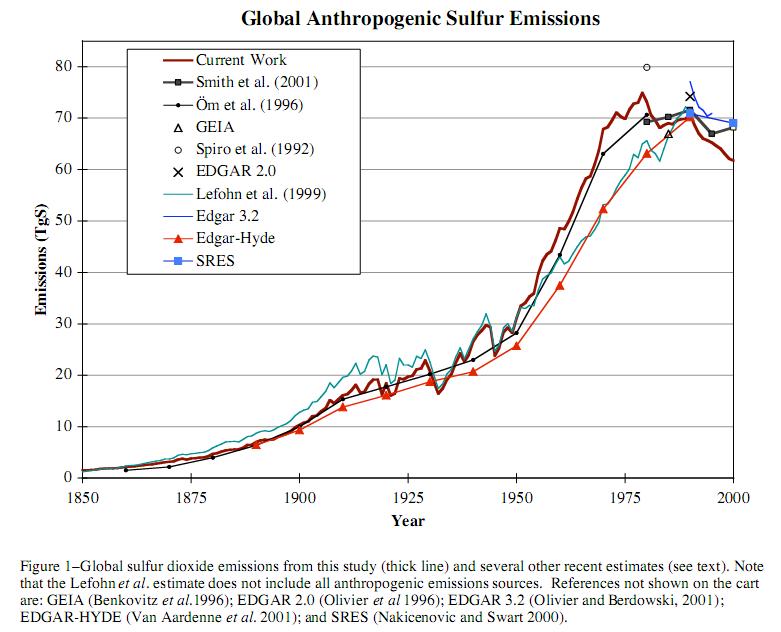
    How does the mainstream scientific community explain this pattern? Why was warming interrupted from 1940-1975? Here is a very simplified explanation: the early (~1915-1940) warming trend has a different explanation to the ~1975-2010 warming trend, and the cooling in between has yet a third explanation. The earlier warming was due to "a combination of factors, including a lull in volcanic activity (therefore the absence of its cooling influence), a slight increase in solar output, and yes, an increase in greenhouse gases too (although not nearly so much as during more recent times)". The second warming period was caused largely by our industrial emissions: mostly CO2, but other greenhouse gases played a role. The lull in warming from 1940-1975, in turn, was due to anthropogenic cooling due to global dimming. The quick version is that aerosols such as sulfates increased very rapidly from about 1940 to about 1975 (spot the relationship?) and then declined again rapidly. In other words, the warming forcing of the greenhouse gases was masked by the cooling forcing of various aerosols, and the rapid decline of the latter after 1975 meant net radiative forcing suddenly turned positive - resulting in warming. While this is undoubtedly complicated (though, what would you expect?) and may even seem contrived, it is important to note that this version of events is consistent with the available data and no other scenario is consistent with the available data.

    But how does someone who agrees that global warming has occurred but denies anthropogenic forcing is responsible, explain the observed temperature record? (And, importantly, the pattern of warming). To think both the above propositions true, you have to believe the darnedest things: (1) that some mechanism entirely unknown to science inhibits or obviates the warming effects of our greenhouse gas emissions and (2) that some other mechanism entirely unknown to science caused the warming that has been observed. We know beyond all reasonable doubt that carbon dioxide is a greenhouse gas - it's a basic finding of physics, established under the most rigorous laboratory conditions. We also know, beyond all reasonable doubt, that the atmospheric concentration of greenhouse gases has increased dramatically because of our industrial emissions since the Industrial Revolution. To think these two facts don't combine to produce warming is to think that there is something (no one knows what) that somehow (no one knows how) inhibits the warming that would normally occur. But worse, there is yet something else (no one knows what) that actually caused to warming we see. (Something must cause it! And it's not the sun, in case you were wondering).

    To be a climate denialist, then, you need to believe at least one of the following: that there is a grand conspiracy among scientists to withhold the truth about the climate record or that, extraordinarily improbably, (1) and (2) are true. On the first, note that there is no precedent in all of history for the existence of a conspiracy on the scale climate scientists have been accused of. ("Climategate" was a non-event. No fewer than three independent inquiries concluded there was no serious misconduct). On the second, extraordinary claims require extraordinary evidence and, as far as I know at least, no one has yet provided convincing, let alone extraordinary, evidence for either (1) or (2).

    My Zimbabwean two cents worth: Vegter is no idiot (I actually quite like him) and, unlike several other climate denialists, I think it highly unlikely he's in the pocket of Big Pollution. My view is that he suffers from immense confirmation bias given that, as a libertarian, he doesn't want global warming to be true. One thing is clear, though, and this should give Vegter some comfort: the truth of climate change is logically independent of what our political response to it should be. It is possible to think - as Bjorn Lomborg's new book demonstrates - that climate change is real and a serious problem, without thinking policies libertarians despise are the remedy. A final note: as George Monboit nicely illustrated recently, there is honor is saying "I was wrong". Ivo, it's time to change your mind.

    Friday, August 27, 2010

    Joburg Skeptics in the Pub: The Plait edition

    It's almost time for the next monthly Skeptics in the Pub Joburg, scheduled for Wednesday, September 1st at 19:30. This time round we're meeting in Sandton (full address below and see the Facebook page for more details). We'll be screening and then discussing Phil Plait's much-debated "Don't Be A Dick" speech at TAM8, which Phil posted about in three parts. Alternate views you might want to look into include Jerry Coyne's critique (see also Dawkins' comment on that post) and PZ's takedown.

    Anyway, please come join us for a beer (or three) and some skeptical goodness....

    Full address: McGinty’s Pub, Morningside Medical Mews
    4 Hill Road, Morningside
    Sandton, South Africa

    Sunday, June 20, 2010

    Anecdotes as evidence

    An anecdote is a tale, story or an account of events that is sometimes humorous or meant to convey a moral, but is often taken as evidence. In this latter sense there are two broad categories. Firstly, there is testimony, i.e., inferring that such-and-such happened or is true because someone said so. For simplicity's sake, we can further divide testimony into a bunch of different subtypes, most notably, into eyewitness testimony, expert testimony and hearsay. The second broad category of anecdotal evidence is personal experiences (or, if you will, ‘personal testimony’) that takes the form 'I saw so-and-so, therefore it is reasonable for me to believe such-and-such'. Note the key similarity and key difference between these two categories: in both cases someone's experience (or alleged experience) is taken as evidence for some claim, but, for testimony and not for one's own experiences, one has to believe a particular experience occurred on someone else's say-so. Now, it seems perfectly reasonable to believe some things on testimony or personal experience - indeed life would be impossible without it. I am currently having the personal experience of sitting on my couch with my notebook on my lap while typing this post. Hyperbolic doubt aside, I have no good reasons to doubt that his is what is really going on, and you have little reason to doubt my testimony. On the other hand, however, it is common for people to believe wild or improbable things – that aliens regularly visit earth, that highly diluted substances can cure any illness, etc. – solely on the strength of anecdotes. So what exactly is the evidentiary status of anecdotes?

    It is vital, first, to distinguish between two types of proposition that anecdotes can be claimed to be evidence for: causal and observational propositions. A causal claim is of the form “P caused X” (or “P, Q and R caused X”) and an observational proposition is “P happened” (or “P occurred, then Q happen and after that R”). This distinction is important for a simple reason: an anecdote can in isolation (almost) never establish the truth or falsehood of a causal claim, it can only be evidence for observational propositions. Why this is the case will be clearer if we think through some concrete examples.

    Consider the claim “Mary cheated on John with Bob”. This kind of proposition is pretty straightforward. I can convince myself it is true simply by determining whether Mary and John are in an exclusive relationship, and, if I see Mary make out with Bob, I can reasonably conclude the proposition is true. Now, obviously, there are a bunch of ways I could get it wrong: maybe the woman involved wasn’t Mary, maybe it was simply a friendly hello kiss, or maybe Mary had broken up with John (so it’s making out, but not cheating). It’s clear, though, that if I’m just a little careful, there are a wide variety of circumstances in which I could be very confident Mary did in fact cheat based on my personal experiences. There are a couple of extra complications when John has to decide whether to believe my testimony – maybe I’m lying, for example – but, again, these are not difficult to understand even if they’re difficult to deal with in practice. In other words, we here have a clear case of an anecdote – both in the sense of personal experience and testimony – that can be a good reason to accept the truth of some proposition. Notice two things, though: the claim is not a causal one, and the plausibility (or prior probability) of it being true is pretty high since we know people do in fact cheat on each other regularly. I’ll explain what the latter means in a bit, but let’s move on to anecdotes as evidence for causal claims.

    So consider the causal proposition “I took medicine X, I got better, therefore I got better because of medicine X”. This claim is much more complicated than the one about Mary, and you can’t determine whether it’s true simply by looking or making a few observations. Why? Because causality is counterfactual: to say A caused B, is to say B would not have occurred if A had not occurred. (There is a long-standing and complicated philosophical debate about causality. Take it from me: steer clear and stick to the counterfactual view). So, on our example, when you claim “medicine X caused my recovery” you’re committed to the counterfactual proposition that you wouldn’t have gotten better had you not taken medicine X. And you simply cannot, even in principle, know this. For one thing, you have an immune system (gasp!) which may have fought off your infection irrespective of whether you took the medicine. Alternatively, you could have ingested some other substance - maybe you took medicine Y as well, maybe you ate something therapeutic - that took care of the infection. In other words, there are a whole bunch of things - i.e. confounds - that could have caused your recovery, and a single observation – the source of an anecdote – simply cannot distinguish between them. In general, the only reliable way to establish the truth or falsity of causal claims is to do controlled experiments. Let’s look at this a bit more closely.

    Assume we are trying to understand the causal relationship between four dichotomous and independent variables (A-D) and a particular dichotomous outcome (O). Assume also that these four variables exhaust the universe of all variables even conceivably related to the outcome. Our aim is to make either inclusion inferences (i.e. conclude the relevant variable has a causal relationship to the outcome) or exclusion inferences (i.e. that the variable does not have a causal relationship to the outcome). Given these assumptions, inclusion inferences are valid only when, from:

    A1   B1   C1   D1  =>  O1
    A2   B1   C1   D1  => O2

    it is concluded that A1 caused O1. The inference is valid because all the variables except one (A) was controlled – held constant – and given the outcome changed, it follows that A is causally related to O. Exclusion inferences are valid only when, from:

    A1   B1   C1    D1   =>  O1
    A2   B1   C1    D1   =>  O1

    it is concluded A1 is not causally related to O1. Again, the validity of the argument is assured because all the variables save one (A) was controlled. Given that A varies while O does not, it follows that A is not causally related to O. Notice that in both cases we are comparing one outcome with a counterfactual. The process of engineering such comparisons is called experimentation and it is at the very heart of the scientific method. (These, by the way, are versions of Mill's Methods).

    If we want to determine whether medicine X can cure some disease, we cannot rely on anecdotes because they don’t allow for counterfactual comparison. Assume, for example, that A1 is taking medicine X, and A2 is not taking it; that B1 is having an immune system, and B2 not; that C1 is taking medicine Y, and C2 not taking it; that D1 is being overweight, D2 is not being overweight; and, finally, that O1 is getting better and O2 is not getting better. When we have a single observation - we know that Thaba over there took medicine X, has a healthy immune system, that he isn't taking medicine Y, that he's rather overweight and that he got better after a few days - all we have is:

    A1   B1   C1    D2   =>  O1

    We have no proper counterfactual: we have not controlled for variables B, C, or D so we can't make any logical inferences about variable A. (Making this inference is the post hoc fallacy). At best, we can say that taking the medicine is possibly related to getting better, but then the same goes for B, C and D. Note also that adding more anecdotes does not resolve our problem: in the real world there are many more than just four variables so things are much more complicated, experiments involving humans are always possibly confounded by the placebo effect, and, importantly, the variables may interact in complex ways. In the oft repeated phrase, the plural of anecdote is anecdotes, not data. Thousands of anecdotes are no more convincing that a single anecdote. As a result, then, anecdotes cannot in general (that is, barring extreme exceptions) establish the truth or falsity of causal propositions.

    As I showed above anecdotes can reasonably be taken as convincing evidence for observational claims. But that does not mean we should believe every anecdote (concerning observational propositions). Bob Carrol of Skepdic (an excellent resource worth referring to often, by the way) nicely enumerates the possible problems:
    Anecdotes are unreliable for various reasons. Stories are prone to contamination by beliefs, later experiences, feedback, selective attention to details, and so on. Most stories get distorted in the telling and the retelling. Events get exaggerated. Time sequences get confused. Details get muddled. Memories are imperfect and selective; they are often filled in after the fact. People misinterpret their experiences. Experiences are conditioned by biases, memories, and beliefs, so people's perceptions might not be accurate. Most people aren't expecting to be deceived, so they may not be aware of deceptions that others might engage in. Some people make up stories. Some stories are delusions. Sometimes events are inappropriately deemed psychic simply because they seem improbable when they might not be that improbable after all. In short, anecdotes are inherently problematic and are usually impossible to test for accuracy.
    In other words, while anecdotes can be good evidence for believing observational propositions - "x happened" - for the reasons listed above, we certainly can't accept all anecdotes uncritically. So what to do? Life is impossible if we dismiss all anecdotes, but we'll be led astray if we accept all anecdotes. The solution is skepticism: that is, being open minded but then filtering beliefs through a bullshit detector. Doing this is simple in principle, but incredibly difficult in practice, so some examples are in order. (Recommended books: Thinking About Thinking by Anthony Flew, The Demon-Haunted World by Carl Sagan [my review], Truth by Simon Blackburn [my review], and Mistakes Were Made (But Not by Me) by Travis & Aronson [my review]).

    Megan Fox: not in Jeff's league. 
    One of the most important and useful bullshit detecting skills is weighing up the evidence against the plausibility of the claim (here is an example of me doing this). Determine, firstly, how plausible the claim is given everything else we know. For example, given everything I know about my friend Jeff, people in general and the state of technology, the proposition that he has flown in an airplane at least once is highly plausible. (He is middle-class, airplane tickets are cheap and abundant, I've seen him in other cities, etc.). On the contrary, given everything we know, it is extremely implausible that he once had a threesome with Megan Fox and Jessica Alba. (For one thing, he is short and balding. For another,  he's never been to the US). The threesome claim is an extraordinary one: given what we know about attractive celebrities, balding South African men, sexual psychology, and so on, Jeff having a threesome with Fox and Alba is just not the kind of thing we expect to happen. Having determined the plausibility of a claim, the next step is to assess the strength of the evidence. In our example, all the evidence we have is Jeff's testimony. As Bob Carrol explained above, anecdotes are often unreliable because people suffer from innumerable cognitive biases and, more obviously, they sometimes lie. Since in the Alba-Fox example Jeff has a strong motivation to lie - having it believed is highly status-enhancing - his testimony is further undermined. What we have, then, is an extraordinary claim, the only evidence for which is very weak. It is reasonable, then, to withhold assent until better evidence is provided.

    A somewhat more enlightening example is alien abduction. People from all over the world claim to have been abducted by extraterrestrials and then molested, lectured on the necessity of world peace, and so on. So, step one: how plausible are these claims? Given what we know about physics and human psychology, not very. First of all, we currently have no evidence that life - let alone intelligent life - exists anywhere else in the universe. (My gut tells me alien life is abundant, but as Carl Sagan pointed out, we shouldn't think with our guts). Secondly, if intelligent life does exist, the aliens will in all likelihood be tens of light-years or more distant, and, since we have no reason to think faster than light travel is practicable, there is no known way for aliens to get to earth in a reasonable period of time. Step two: what about the evidence? Again we have anecdotes: tales from people who claim to have been abducted. Significantly for this example, there is a highly plausible alternative explanation that undermines the evidentiary status of the accounts, namely, hypnogogia and hympnopompia. Briefly, these are vivid hallucinations that occur as you're falling asleep or waking up that are accompanied by sleep paralysis. Typically, a person wakes up terrified and unable to move, senses (an often malevolent) 'presence' in the room, and may also experience a variety of visual, auditory and proprioceptionary hallucinations. Tellingly, this well-studied phenomenon closely mirrors accounts of alien abduction, which often feature extreme fear, a 'presence' in the room, and being unable to move. Since these experiences are accompanied by visual hallucinations and alien visitation is a common trope in popular culture, the other reported experiences are easily accounted for. Importantly, also, hypnogogia and hypnopompia are common (much more common than claims of alien abduction). Extraordinary claims require extraordinary evidence. Since claims of abduction are extraordinary, anecdotes of being abducted are far from extraordinary evidence, so, until much more evidence is provided, it is reasonable to withhold assent.

    So... what exactly is the evidentiary status of anecdotes? In summary: (1) anecdotes on their own can never establish the truth or falsity of causal propositions. (2) While anecdotes can be evidence for observational propositions, the plausibility of the claim must be taken into account. To be believed, highly implausible claims require much, much more than mere anecdotes.

    Thursday, June 17, 2010

    The Randi Prayer

    The beautiful Randi Prayer, by Crispian Jago of Science, Reason and Critical Thinking....
    Our Conjuror
    Who art in Florida
    Amazing be thy name
    Thy Million-Dollar Challenge
    Will not be done
    Give us this day
    Empirical evidence
    And debunk our irrationality
    As we debunk those who make unsubstantiated claims to us
    And lead us not into woo woo
    But deliver us from credulity
    For thine is the rationality
    The logic and the reason
    Until unequivocal evidence proves otherwise

    Wednesday, June 9, 2010

    Skeptics in the Pizzeria

    The next - and for Angela and I, final - Durban Skeptics in the Pizzeria is scheduled for Thursday, June 17th from 18:30 till late at Pizzetta. (It'll be our final one because we're moving to Joburg at the end of the month). Come join us!

    A map:


    View Larger Map

    Tuesday, June 1, 2010

    Video: Saving Africa's Witch Children

    Update: I see the video I embedded has been removed. There is, *cough*cough*, a torrent available...

    A documentary (embedded below, or click here) on one of the greatest tragedies of our time: witch hunts in Africa. The only appropriate response is burning indignation. (Note: you can download this video by following the link and creating an account with Vimeo).


    Saving Africa's Witch Children from Africa's Witch Children on Vimeo.

    See also my posts: "Human Sacrifice in Uganda" and "Witch Trials in Africa".

    Sunday, April 18, 2010

    Video: Michael Spencer defends skepticism and science

    Journalist Michael Spencer, author of Denialism: How Irrational Thinking Hinders Scientific Progress, has an excellent TEDTalk out (embedded below or click here). It's a defense of science and rationality delivered with passion, verve, humor and a touch - appropriately - of anger. Highly recommended.

    Monday, March 1, 2010

    Carnival of the Africans #14

    Simon of Amanuensis has put up the 14th edition of the Carnival of the Africans, our humble effort to promote scientific and skeptical blogs from Africa. There are a bunch of very interesting posts to feast on, so do have a look! A selection: Mark from the Grumpy Old Man on the Lancet's retraction of the Wakefield paper and on a quack witchdoctor; Angela from The Skeptic Detective on the South African Society for Paranormal Research; and Simon himself on fMRI evidence for inequality aversion. My contributions to this edition were on deference and the importance of blinding...

    We do need hosts for future editions of the carnival, so if you'd like to take on the responsibility (it's fun...), have a look at the schedule, and drop me an email!

    Saturday, February 27, 2010

    Picture: Why global warming can't be a conspiracy...

    A nice graphic, from Going on a Bear Hunt.


    (via PZ Myers).

    Sunday, February 21, 2010

    Climate denial and arrogance

    I recently became a bit more active on Twitter (find me at @michaelmeadon) and today I had an argument with one Ivo Vegter (@ivovegter), a South African journalist and, more to the point, climate denialist. Vegter is a staunch critic of climate science and he's penned several columns espousing his views, on Climategate, Copenhagen and one answering his critics (among others). I don't have either the time or the inclination to document all the misconceptions, false statements and fallacies Vegter makes in his columns, but I do want to hold forth on intellectual arrogance and share an analogy I put to him regarding expertise. Vegter, you see, is a journalist: he not only has no training in climate science, he has no scientific training at all. He is, apparently, "reasonably familiar with scientific subjects, and ha[s] read...a great deal on the subject of climate change." (Though this does not include, at least from what I can see, reading the scientific literature like respected science journalists do - c.f. Carl Zimmer and Ed Yong). Oddly, he claims "no particular expertise, nor qualifications to challenge professional scientists on matters of high science" but then does exactly that when taking sides between denialists (often non-climate scientist) and proper climate scientists.

    As regular readers will know (I keep reminding you...) I recently wrote a long piece praising intellectual deference. The key premises of my argument there was (1) that the universe is hypercomplicated and (2) that intellectual rigor demands robust epistemic justification before forming an opinion. My conclusion was that, given (1), (2) is extremely difficult to fulfill. Intellectual responsibility, then, demands either agnosticism or deference to expert consensus when (2) is not fulfilled. I think it should be obvious that climate science is in fact preposterously complicated. To make up your own mind, all by yourself, about whether human activities cause global climate change, you would need to understand, at a minimum and as far as this particular non-expert can tell, the relevant physical and chemical processes that happen in the atmosphere and how they change, the history of and variations in climatic conditions, the extent and history of anthropogenic greenhouse gasses, and the mathematics that underlie climate models. To form justified opinions about these, in turn, you’d have to know and understand, including all the technical details, a vast body of literature about things like dendroclimatology, meridional overturning circulation, the net radiative forcing of anthropogenic aerosols, and the quasi-biennial oscillation.

    Vegter, as far as I know at least, understands none of the above, let alone at an expert level. Yet he espouses an opinion contrary to scientific consensus. (While there is plenty we don't know, the vast majority of the relevant experts agree climate change is anthropogenic). Without properly understanding the methods of science, he claims, absurdly, that "Climategate" shows there is a warmist conspiracy. He adjudicates arguments between scientists and denialists - usually in favor of the latter. All of this, I think, is irresponsible and arrogant in the extreme. As I pointed out in my deference piece:
    It is extraordinarily arrogant to have (independent) opinions on complex questions without being willing to pay your dues first – that is, without studying the question for years, reading the scholarly literature, mastering the relevant techniques and mathematics, and so on. Thinking you are entitled to an opinion without paying your dues is the very epitome of intellectual arrogance. And it is especially arrogant – mind-bogglingly so – for a non-expert to have opinions that contradict the consensus of the tens of thousands of intelligent, diligent and dedicated people who have spent decades studying, debating, doing research on and thinking deeply about their respective disciplines. The bottom line: be an expert, defer, or suspend judgment.
    There is, I've noticed, an odd inconsistency in lay arrogance about science. I doubt very much Vegter would grab the knife away from a neurosurgeon and start cutting away himself. I doubt Vegter would tell an engineer she's Doing It Wrong and redraw her plans for a bridge. And yet Vegter seems perfectly willing to yell 'bunkum!', 'conspiracy!' and 'fraud!' when it comes to climate science, despite the fact that the topic is arguably much more complicated and the stakes several orders of magnitude higher. Why not watch MegaStructures on Natural Geographic and start an engineering firm? Why not browse through Gray's Anatomy, read a bit of Oliver Sacks and then branch out to neurosurgery? He's done neither physics nor physiology, but seems willing to advise climate scientists on the strength of his ignorance on the former, but not neurosurgeons on the strength of his ignorance in the latter. Why?

    Friday, February 19, 2010

    Skeptics' Circle #130

    I've not pointed to Skeptics' Circles in a while (naughty, I know). So here's the latest. the 130th edition of the Skeptics' Circle is up over at The Lay Scientist. Posts to check out: Martin on the 10:23 mass homeopathy overdose, Andrea's Buzzing About on the false distinction been 'natural' and 'artificial' chemicals, and Dubito Ergo Sum on Mike Adams' (of the quackery site Natural News) stupid views about skeptics. My contribution to this edition was "In Praise of Deference".

    Andreas Moritz is (also) a quack

    So I wrote yesterday about one Christopher Maloney, a naturopathy quack. It turns out he was not responsible for getting Michael Hawkins' blog shut down, the villain responsible is Andreas Moritz, a cancer quack. PZ has posted the letter Moritz has sent to Hawkins, in which he threatens to sue for defamation. Yeah, right. Smart move - now the whole internets will be one your case. Streisand effect FTW.

    See: Orac's takedown of Moritz, published long before this whole snafu.

    Update: Orac has taken on Andreas Moritz again.

    Thursday, February 18, 2010

    Christopher Maloney is a quack

    Now this is rather shocking. Wordpress has shut down the blog of a University of Maine student, Michael Hawkins, for having the temerity to criticize a Naturopath quack cancer quack. Luckily, PZ Myers has unleashed the power of the Streisand effect. So let's just be clear. Naturopathy is bullshit. And Christopher Maloney is a quack. And... Shame on Wordpress.

    Update: the quack in question has written to PZ Myers to complain, and says it wasn't him who contacted Wordpress to shut down Hawkins' blog. Also: see Steven Novella's take on the incident.

    Update 2: Andreas Moritz, a cancer quack, is actually responsible for taking Hawkins' blog down. See this.